
Trails, Neighbors and Crime: What Does the Research Show?
When a trail is proposed near someone’s home, questions about safety are understandable. Will it bring strangers close to the property? Will it increase break-ins? What happens if problems arise?
Research provides reasons for reassurance. Several studies have found no increase in crime near trails and greenways, while others have found reductions. The findings do not mean crime can never happen on a trail. They do challenge the assumption that adding a trail makes a neighborhood more dangerous.
For homeowners, an especially useful question is what happens to crime on nearby properties—not simply whether an incident has ever occurred on a trail.
What have we learned in North Carolina?
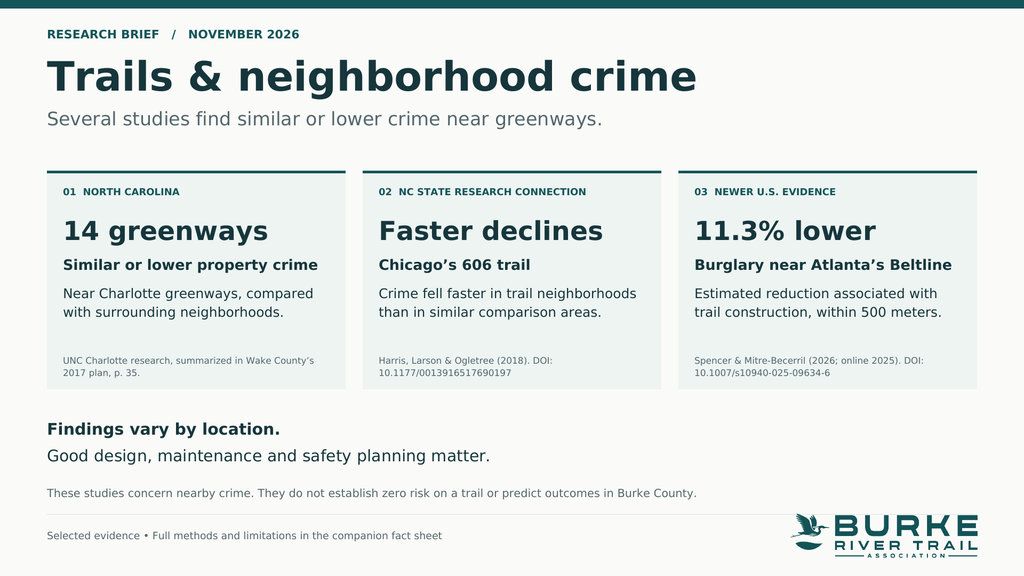
Charlotte: Similar or lower property crime near greenways
The Wake County Greenway System Plan summarizes UNC Charlotte research examining properties near 14 Charlotte greenways. It reports that property-crime rates were either not significantly different from, or lower than, those in surrounding neighborhoods.
This is relevant to the concern that a trail beside a home creates a greater risk of property crime. The findings did not support that assumption in the areas studied.
This is historical evidence, not a description of today’s crime rates. The source linked here is the county plan’s summary of the research.
Read the Wake County Greenway System Plan, page 35
Cary: Most surveyed neighbors were satisfied
A 1995 survey of households near three Cary greenways found that most respondents were satisfied with the greenways and that problems were generally limited, according to published summaries.
Some residents did report concerns, including trespassing, noise, roaming pets and privacy. Those experiences matter and help identify issues to address during planning and management.
The survey’s often-cited 75% figure was its response rate, not the percentage of residents who felt satisfied. This was a study of residents’ experiences and perceptions, not a measurement proving that crime never occurred.
Read the summary of the Cary study
Chapel Hill: Results were mixed
A 2005 UNC Chapel Hill master’s project compared crime near three greenways before and after opening with crime in similar comparison areas. Two greenways showed no apparent effect on crime; one showed increased nearby crime density.
The study did not establish that the trail caused the increase. Its mixed findings are a reminder that individual places differ and that no single study can settle the question for every community.
Read the Chapel Hill study and findings
What does research elsewhere show?
Atlanta: Lower burglary near Beltline construction
A newer peer-reviewed study examined Atlanta crime data from 2009 through 2024 and the timing of Beltline trail construction. Researchers estimated an 11.3% reduction in burglary within 500 meters—about one-third of a mile—of trail construction.
That finding is relevant to concerns about break-ins. It describes a neighborhood-level result, however, not a guaranteed reduction in risk for each home or a prediction for Burke County.
Read the published study’s abstract
Chicago: Faster crime declines near The 606
Research involving NC State faculty found that violent, property and disorderly crime declined faster in neighborhoods near Chicago’s 606 trail than in similar comparison neighborhoods. At a closer geographic scale, the relationship was strongest for property crime.
The findings suggest that a greenway can be part of a positive neighborhood change. They do not establish that the trail alone produced every improvement.
Read NC State’s explanation of the research
Indianapolis: No detected increase in the preferred analysis
A working paper examined crime around Indianapolis trail segments opened between 1995 and 2006. Some analyses showed reductions, while the author’s preferred statistical approach found no significant change.
The most defensible takeaway is that the study did not find evidence that opening those trails increased nearby crime.
Read the Indianapolis research paper
Safety still requires planning and care
A trail’s design and management matter. Regular use can bring more people into view of a corridor.
Useful safety measures include:
- Clear sightlines and maintained vegetation.
- Clearly marked public access and private-property boundaries.
- Emergency access and signs that help users describe their location.
- Appropriate lighting where the setting and operating hours call for it.
- Clear rules, prompt maintenance and a way to report concerns.
- Coordination among trail managers, neighbors and local law enforcement.
Buncombe County’s greenway safety guidance explains how design, maintenance and community involvement can support safer trails.
What does this mean for Burke County?
The available research does not justify assuming that a trail will bring more crime to nearby homes. It also does not eliminate the need to listen to neighbors or address specific concerns.
The useful conversation is about the actual location: property boundaries, visibility, access, maintenance and how problems will be handled. Research can inform that conversation, and local experience should continue to inform it after a trail opens.
Have a question about a proposed Burke River Trail section near your property? Connect with the Burke River Trail Association to discuss the location and your concerns.
Research reviewed November 2026. This page summarizes selected studies and planning documents. Study locations, methods and time periods differ; the findings are not a forecast of crime in Burke County.